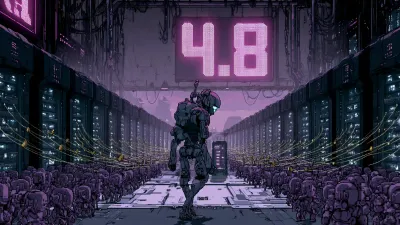
The move described below was pulled on the day it was due. On June 15 Anthropic told subscribers “pricing for the Claude Agent SDK isn’t changing for the time being,” that it’s “revising the plan to better support how users build with Claude subscriptions,” and that it will give advance notice before any future change. So claude -p, the Agent SDK, GitHub Actions, and third-party apps still draw from your subscription, with no credit to claim. The essay stands as written for May 25 and describes the change as announced. The direction held; the date didn’t. Read the present-tense “June 15” passages below as the plan, not the outcome.
On June 15, Anthropic moves claude -p, the Agent SDK, Claude Code GitHub Actions, and third-party agents off your subscription limit and onto a separate metered credit, billed at full API rates with no rollover. Interactive Claude Code stays on your seat. Everything you scripted does not.
That is the tell. Not the price. The line they drew. The subscription was never paying for the model. It was subsidising the assumption that a human was in the loop, typing, at human speed.
What June 15 Actually Changes
The headline reads like a billing tweak. The mechanism is a redefinition of what a seat covers.
-pwas the loophole. The print/headless flag is how you wire Claude Code into a cron job, a CI step, a Ralph Wiggum loop. It ran under your Max seat like any other invocation.- Now automation has its own meter.
-p, the Agent SDK, GitHub Actions, and third-party clients draw from a separate credit ($20 Pro / $100 Max 5x / $200 Max 20x), priced at API list rates, no rollover. - The gap is enormous. A single heavy session burns 500K to 1M tokens. Independent estimates put the effective change at roughly 12x for light use and 150x+ for heavy automation versus the old subsidised path.
This is the natural endpoint of the walled-garden crackdown and the billing enforcement that followed. First they asked who was calling. Then they stopped caring who, and started counting how much.
The Pattern, Not the Incident
I covered the three-vendor version of this in Copilot Tokenizes the Trilogy. June 15 is the fourth beat, and now the shape is undeniable:
- Cursor, June 2025: broke “unlimited,” moved to a credit pool, apologised, refunded.
- Anthropic Enterprise, November 2025: dropped the seat to ~$20 and stopped including tokens at all. The seat buys platform access and zero usage; every token meters at full API rate on top. Enterprise is already, in substance, token-based.
- GitHub Copilot, June 1 2026: every plan moves to usage-based AI Credits.
- Anthropic, June 15 2026: automation comes off the seat entirely.
Twelve months, four vendors, one direction. Nobody coordinated it. They all hit the same wall.
Why the Seat Never Fit
A per-seat license is a bet: one human, roughly one bounded workload. It worked for autocomplete and chat because a person can only type, read, and approve so fast. The seat was a flat rate on a capped appetite.
Agents removed the cap. One seat can now fan out subagents, run overnight, and consume orders of magnitude more than the person it was sold to. The headcount stopped predicting the consumption. Once that link breaks, flat pricing is just a subsidy waiting to be arbitraged, and it was.
Enterprise Claude already finished the trip: the seat there is a turnstile, not a meal plan, and the meal is metered by the token. June 15 does the same thing to the consumer subscriptions, it just starts with the automated workloads, where the headcount-to-consumption link snapped first.
The subscription didn’t get more expensive. The thing it was pricing changed underneath it. A seat was always rent for a chair. Nobody priced the robot you sat in the chair.
Metering is the honest correction. If you consume like a fleet, you pay like a fleet. That is defensible, even good.
What Metering Doesn’t Fix
The honest pushback, because “more honest pricing” is not the same as “better for you.”
- Budgeting gets harder, not easier. A flat seat is forecastable. A metered loop is a variable bill that spikes with exactly the workloads you most want to run.
- No rollover punishes spiky use. Real automation is bursty: nothing for days, then a giant refactor. Use-it-or-lose-it credits penalise that shape.
- It taxes the behaviour they taught us. A year of tooling pushed everyone toward headless loops and agent fleets. June 15 puts a meter on the meter-running, which will quietly kill a class of experiments that only made sense when they were free.
- Light users may genuinely win. If you mostly sit in the interactive TUI, this barely touches you, and you stop subsidising the people running datacentre-scale loops on a $200 plan.
Run your headless workloads with --output-format json now, while it’s still free, and log the token counts. You want a real baseline of what your automation actually costs before June 15 turns that number into an invoice. Cap the loops that surprise you.
Closing
The flat seat was a beautiful anomaly: for about a year, you could rent a chair and seat a tireless machine in it. June 15 ends the part of that anomaly that mattered most, the part where the machine ran for free.
Metered automation is the correct price. It is also a reminder that none of this was ever priced for what we’re actually doing with it. The seat was for a person. The bill is for the fleet.
Related Posts