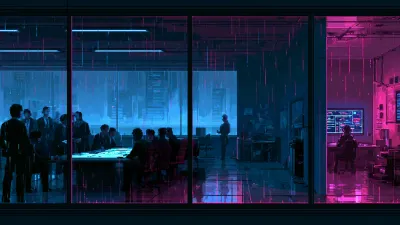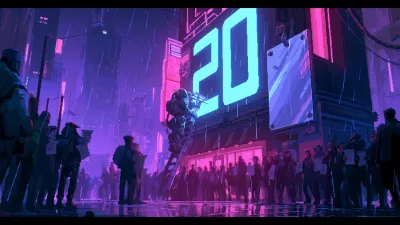
Remember the mining machines in Avatar? Huge bulldozers, side by side, flattening forest faster than anyone on foot can follow.
That’s software delivery now. Engineers ride the bulldozers. The agents are the engines. Everyone else stands in the clearing, coughing, trying to work out where the road is going.
We Showed Everyone the Engine Room
In February I argued that your PM tool was designed for humans, and the PM tool of the agent era is an API agents consume. On a recent project with an outside vendor, we did exactly that. Agents wrote to the tracker. We invited everyone in, the vendor too.
The tracker now holds hundreds of tickets, most filed by me and my agents, with thousands of discussion threads around them. Dozens are cancelled or duplicate. Dozens more carry their own change history: “superseded”, “replaces”, “the ask changed on”. Design docs went through version after version.
All of it was honest. None of it was readable. People were unhappy, and nobody could answer the only question that mattered: are we on track?
The Old Playbook Assumes Slow Change
Traditional project management assumes a plan holds still long enough to measure against. That’s gone.
- Specs are disposable. An agent regenerates a spec in minutes, so it gets regenerated every time an assumption moves.
- Goalposts move hourly. A prototype on Tuesday changes what “done” means on Wednesday. The goalposts really do move more often now, and stakeholders feel each move as confusion: what did we agree, and is that still true?
- The work never clocks off. Agents work in teams after 5pm and through the weekend. My agents and I average about 150 commits a day, seven days a week. Weekends barely dip. By Monday morning, the plan you left on Friday has hundreds of commits against it. Nobody can be expected to keep up with that.
- Ceremonies shrink instead of dying. Teams cut sprints from two weeks to three days and keep the ritual.
— ern, Hacker NewsI still find people trying to run sprints when working with agents, but then saying things like “my sprint length went from 10 days, to 5 days to 3 days”, but they balk at the notion that maybe sprints aren’t fit for purpose anymore.
The volume is the other problem. Linear reports its own merged PRs went up 153% between January and October. No person reads that much. One developer on Hacker News put it plainly: “I can’t process this much information.”
Cognitive Mercantilism, and the Opposite Mistake
Venkatesh Rao’s Cognitive Mercantilism argues that AI panic copies early mercantilism. Elites treat intelligence as scarce, hoard it like bullion, and don’t trust ordinary people with it.
His counter is the farm. Farming went from most people’s job to almost nobody’s. People didn’t starve. They ate better.
— Venkatesh RaoThe analogous possibility with AI is that most people will no longer need to be significant producers of intelligence in order to become significant consumers of it.
We made the opposite mistake. We didn’t hoard anything. We handed everyone the whole farm: every field, every failed crop, every argument about irrigation. Then we asked them to work out what was for dinner.
Rao also says “the returns on attention rise” when intelligence is cheap. That holds only when the thing you look at pays you back. A raw board of hundreds of agent-written tickets doesn’t. People looked, learned nothing, and felt less in control than before.
“Keep it to the engineers” sounds like the mercantilism Rao attacks. It isn’t, if the sponsor still gets all the evidence. What changes is the packaging, not the access. Hide the debate, never the bad news.
Four Lenses, Not One Board
Goldman just drew this line for the tools: it kept Claude Code with its engineers, the people who answer for what it ships. The inner workings belong on the same side of the line.
Engineering tracking isn’t a PM concern. A PM manages stakeholders. So the split is four layers, each for one audience:
| Layer | Who reads it | What it holds |
|---|---|---|
| Engineering | Engineers and agents | Tickets, spikes, debate, dead ends |
| Delivery | PM | Milestones with dates, risks, decisions |
| Shared | PM and vendor | What each side owes the other, and by when |
| Status | Sponsor | Health per milestone, with evidence |
Only the first layer is a board. The rest should be generated, not maintained. A board someone has to keep current goes stale the day the bulldozers speed up. This extends briefs as code: same repo, more readers.
A First Try: Project Observability
Today I tried this as a skill. It runs on a cadence and writes three short PDFs: a sponsor health check, a PM update and a vendor pack. The rules matter more than the tooling:
- Code computes the state, the model writes last. A script reads the plan, the tracker and GitHub, and works out each milestone in code. The model only writes the words.
- A closed ticket is a claim, not evidence. “The tracker shows it as Done” is never “it is done”. A milestone closes only when a person confirms it.
- “Insufficient evidence” is a valid answer. Silence becomes visible instead of reading as progress.
- No single traffic light. One colour for a whole project hides more than it shows.
- The vendor pack gets checked by code. It can’t leak ticket ids, internal links or internal dates.
The first run surfaced places where our own sources disagreed with each other, which the raw board had hidden in plain sight.
This ran once, on a local branch. Nobody outside the team has read the output yet. It’s a first experiment, not a proven system.
What This Doesn’t Solve
- Someone still has to agree the plan. Dates and milestones are the one hand-kept input. If nobody owns them, no lens helps.
- Less visible can look like hiding. When people are already unhappy, a cleaner view reads as spin unless the evidence sits one click away.
- Generated status can be confidently wrong. That’s why code computes it and a person reads every page before it goes out.
- It doesn’t make people faster. It gives them something worth reading at the speed they already have.
Give Them the Ridge
The bulldozers won’t slow down, and they shouldn’t. But not everyone needs a seat in the cab. Most people need a view from the ridge: where the road goes, how far it has come, and what’s in the way.
Engineers keep the forest. Everyone else gets the map.
Related Posts