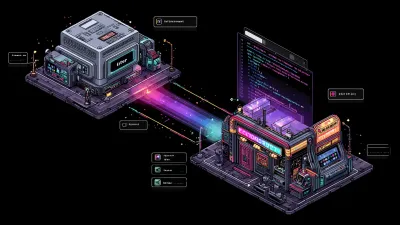
I asked Claude to redesign my blog.
Then I asked Claude to implement Claude’s redesign.
This is what shipped. You’re reading it.
The Setup
Anthropic released claude.ai/design on Friday. It’s an Anthropic Labs product, powered by Opus 4.7, with Canva’s Design Engine doing the rendering under the hood. The pitch: turn prompts into prototypes, slides, one-pagers, and full design handoffs. Figma’s stock dropped about 7% the same day. Mike Krieger, Anthropic’s CPO, had quietly resigned from the Figma board four days earlier.
The killer feature, on paper, is that it can read your existing codebase and pull out your design system. Colors, typography, components. It then generates new work that’s already on-brand.
So I pointed it at this blog.
The Handoff
Twenty minutes later I had a zip file. Inside: a 26KB README, a 72KB HTML prototype with three toggleable variants (tamed, max, term), and the existing hero image.
The README was unreasonably good. It opened with a thesis:
The current design fires every neon gradient and glow effect simultaneously on every element; this refine commits to a pixel-chrome system where glow is earned, not sprayed.— Blog Refine handoff README
That’s a real diagnosis. It then enumerated the specific offenders: tri-color gradient on h1 and strong tags, glowing ::before borders on every table and list, a body-level radial bloom firing pink, purple, and cyan all at once, a header gradient strip that clashed with the rest of the palette. It proposed a token system, called out the back-compat aliases needed so existing variable names still resolve, and gave a suggested implementation order starting with tokens because “it unblocks everything.”
It even told me which variant to ship. The prototype had three toggleable themes. The README said: ignore the other two, only tamed is the target.
That last detail is the part that made me laugh. The AI designer also opinionated about which design direction to commit to. It didn’t punt the choice back at me.
The Implementation
I dropped the export into Claude Code and asked it to incorporate what made sense without rewriting the whole site.
Tier-one changes that shipped:
- New token block in
global.csswith cyan as the system primary, magenta reserved for highlight, violet for tertiary. Old variable names aliased forward so nothing broke. - The body
::beforetri-radial bloom is gone. Replaced with subtle paper grain. - Gradient text-fill stripped from
h1andstrong. Bold text is now plain white. It is much more readable. - Tables: no more glowing top edge, no more inset cyan box-shadow stack. Flat ground with a 1px rule.
- Lists: no more glow-bordered panels around every
ulandol. Numbered bullets are pixel01 / 02 / 03instead of gradient circles. - Header: solid
--ground-0with a 1px bottom rule, brand text in Press Start 2P, and a single blinking cyan status dot. The blue-to-purple gradient strip is gone. - Footer: rainbow
::beforeline removed, social chips are square pixel buttons instead of pink rounded circles. Notecallouts now use a[NOTE]/[WARN]/[TIP]Press Start 2P prefix and a 3px left accent, no gradient washes.
What I deliberately skipped: the full hero rewrite with a typed boot block, the Ctrl+K terminal overlay redesign, the deep archive list section, the post-head reshape on individual articles, and the author bio card. Those are bigger surgical jobs. The README is detailed enough that I can come back and pick them off one at a time.
What Actually Happened, Recursively
The thing I keep coming back to is the loop.
Claude (via Canva’s design engine) generated the design. Claude (Code) implemented the design. I sat in the middle as art director and project manager, mostly saying “do that” and “skip that.” There was no Figma file. There was no human designer. There was no handoff meeting. The whole pipeline was one product family, two surfaces, and an export zip moving between them.
That’s not a hypothetical future. That happened today, on this blog, in roughly an hour.
The interesting part isn’t that it worked. It’s that the seam between “I’m designing” and “I’m building” mostly disappeared. The README was the spec. The HTML was the reference. Claude Code read both, asked me to confirm scope, made the edits. The build passed on the first try.
The Honest Caveats
This is not a magic wand. The reactions in the wild are doing the usual two-step.
PCWorld tried it for thirty minutes and got rate-limited for a week. The token burn on real design generation is brutal, and Claude Pro’s weekly cap evaporates fast.
The Register interviewed a designer with twenty-five years of experience who described AI design tools generally as “a slot machine that doesn’t hit.” She also predicted Claude Design will succeed in corporate environments specifically because it produces “something that already happened.”
The top Hacker News thread landed on a similar verdict: “You’ll get competent UI but nothing truly unique or mind-blowing.” The defense, equally common, was that competent UI is exactly what most internal tools need.
All of these critiques are correct, and none of them invalidate the experience I just had. The blog is mine. The aesthetic is mine. The handoff was a refine on top of an existing design system, not a generation from zero. Claude Design did exactly what it was good at: it produced a competent, on-brand, legible iteration on top of work that already existed. It did not invent anything.
That gap, between “competent iteration on existing work” and “novel design from zero”, is the real shape of the product right now.
What This Means For The Pipeline
If you are a solo developer who already has a design vocabulary, this is the missing piece. You can self-direct, you don’t need a designer for the small stuff, and the handoff between “design” and “code” stops being a meeting.
If you are a designer at a company that ships a lot of internal tools, your dashboards just got a lot more competent without you. The slot-machine take is right that the magic doesn’t hit on demand, but the floor of “acceptable enterprise UI” went up significantly overnight.
If you are mid-market, doing brand work that needs to feel distinct, none of this touches you yet. Generating something that “already happened” is the explicit failure mode for that work, not a feature.
The thing I’m sitting with is how natural the loop felt. I didn’t think of myself as a user of two products. I thought of myself as someone moving through a single workflow. The handoff zip was the only artifact that survived the seam, and it was small enough to hand-edit if I needed to.
That’s the bar now. Not “can the AI design,” but “can the AI design something that the AI can then build, with the human staying in the loop only at the decision points.” On this evidence: yes, mostly, for refinement work, on a codebase the model can read.
Look around the page. Tell me what you think.
Related Posts